
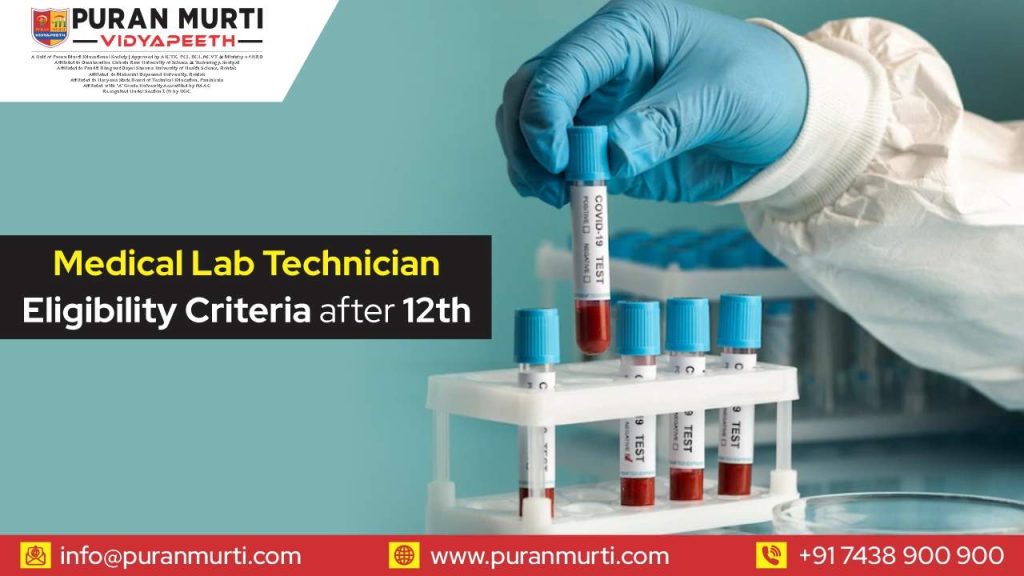
Medical Lab Technician Eligibility After 12th
Posted on : 6 November, 2026 1:52 am
Choosing a career after class 12 is crucial. Although majority of students head towards medicine, engineering, or management, there are numerous other gratifying careers in healthcare apart from embarking on medicine adventure. Among them is a Medical Laboratory Technology (MLT) that is essential in diagnosis of disease and patient care in this age and time.
Medical Lab Technician: If you love biology, lab experiments, and scientific research, then you might want to be a medical lab technician. So, you should know the eligibility of medical lab technician after 12th, subjects, minimum marks, courses, admission, etc., before applying.
At Puran Murti Vidyapeeth, we assist students to explore career-focused healthcare education and understand the academic requirements before choosing a programme. This guide explains the eligibility requirements for DMLT and undergraduate medical laboratory science programmes, along with career opportunities in India.
What Is Medical Laboratory Technology?
Medical Laboratory Technology (MLT) is an allied health profession, the practice of which can be qualified as being concerned with the diagnosis, treatment, and prevention of disease(s) using clinical laboratory tests.
A clinical lab technologist deals with blood cells, tissue, urine, and other cell samples from humans. They employ laboratory instruments and scientific procedures and treatments for accurate diagnostic information for medical practitioners.
What its practitioners are doing:
- Collecting and processing laboratory samples.
- Conducting blood and urine tests.
- Performing basic microbiological investigations.
- Analysing samples using laboratory equipment.
- Maintaining testing records and reports.
- Following laboratory safety and hygiene standards.
- Supporting quality control procedures.
Medical Lab Technician Eligibility Criteria After 12th
Students who want to become medical laboratory technicians generally need to complete their Class 12 education before applying for an appropriate diploma or undergraduate programme.
For the new DMLT competency-based curriculum released by the National Commission for Allied and Healthcare Professions (NCAHP) in July 2026, the prescribed entry qualification is Class 12 Science with Physics, Chemistry and Biology from a recognised board.
Eligibility Criteria at a Glance
| Eligibility Factor | General Requirement |
|---|---|
| Educational qualification | Class 12 from a recognised board |
| Preferred stream | Science |
| Required subjects for the new DMLT curriculum | Physics, Chemistry and Biology |
| Minimum marks | As prescribed by the institution and applicable regulations |
| Entrance examination | Depends on the programme and admission rules |
| Age requirement | As specified in the current admission guidelines |
| Medical fitness | Ability to perform laboratory-related practical work |
Which Medical Laboratory Courses Can You Pursue After 12th?
After completing Class 12, students can explore different educational pathways in medical laboratory science.
1. Diploma in Medical Laboratory Technology (DMLT)
DMLT is a diploma-level programme designed to develop practical and theoretical knowledge of medical laboratory procedures.
Students learn about:
- Clinical pathology
- Haematology
- Clinical biochemistry
- Microbiology
- Blood banking
- Laboratory safety
- Sample collection and processing
The NCAHP competency-based DMLT curriculum released in July 2026 describes a two-year programme for students who have passed Class 12 Science with PCB.
The curriculum focuses on practical competencies and the pre-analytical, analytical and post-analytical stages of laboratory testing.
2. Bachelor of Medical Laboratory Science (BMLS)
Students interested in deeper academic knowledge and broader professional development can explore a bachelor’s degree in medical laboratory science.
The programme focuses on subjects such as:
- Human anatomy and physiology
- Clinical biochemistry
- Medical microbiology
- Haematology
- Immunology
- Histopathology
- Laboratory management
- Diagnostic technology
The updated NCAHP framework also includes competency-based curricula for undergraduate medical laboratory science education.
Before choosing a bachelor’s programme, check its approved nomenclature, duration, entry qualification and university recognition.
DMLT vs BMLS: Which Course Should You Choose?
| Comparison Factor | DMLT | BMLS |
|---|---|---|
| Qualification | Diploma | Undergraduate degree |
| Academic level | Diploma | Bachelor’s |
| Main focus | Laboratory skills and procedures | Broader medical laboratory science education |
| Learning approach | Theory and practical training | Detailed theory, practical and clinical learning |
| Career pathway | Entry-level laboratory roles, subject to qualification and registration rules | Degree-level laboratory science roles, subject to applicable requirements |
| Further education | Relevant advanced programmes, subject to eligibility | Postgraduate medical laboratory science programmes |
How to Become a Medical Lab Technician After 12th?
Follow these steps:
Step 1: Complete Class 12
Complete your higher secondary education from a recognised board. Science students with Physics, Chemistry and Biology have the relevant subject background for DMLT and BMLS programmes.
Step 2: Select the Right Course
Compare DMLT and BMLS programmes. Consider the qualification level, duration, curriculum and future education opportunities.
Step 3: Check College Eligibility
Review the latest admission requirements, minimum marks, subject combinations and any entrance examination requirements for Medical Lab Technician Eligibility After 12th.
Step 4: Submit the Application
Complete the application form and provide accurate academic and personal information.
Step 5: Complete Document Verification
Submit the required educational certificates, identity documents and other admission records.
Step 6: Begin Academic and Practical Training
After admission, focus on classroom learning, laboratory demonstrations, practical sessions and supervised training wherever prescribed.

What Skills Are Required to Become a Medical Lab Technician?
A successful medical laboratory professional should develop:
- Attention to detail: Small errors in sample handling or documentation can affect test reliability.
- Scientific knowledge: Understanding Biology, Chemistry and laboratory procedures.
- Analytical thinking: Interpreting laboratory observations and identifying irregularities.
- Technical skills: Operating laboratory instruments correctly.
- Time management: Handling samples and completing assigned tasks efficiently.
- Communication: Sharing relevant information with healthcare professionals.
- Ethical responsibility: Maintaining patient confidentiality and following professional standards.
Career Opportunities After Completing MLT Courses
| Job Profile | Main Responsibilities |
|---|---|
| Medical Lab Technician | Performing routine laboratory investigations |
| Laboratory Assistant | Supporting sample processing and testing |
| Haematology Technician | Working with blood-related investigations |
| Clinical Biochemistry Technician | Supporting biochemical laboratory testing |
| Microbiology Laboratory Technician | Assisting with microbiological investigations |
| Blood Bank Technician | Supporting blood grouping and related laboratory procedures |
| Quality Control Assistant | Supporting laboratory quality assurance |
| Research Laboratory Assistant | Assisting with laboratory research activities |
Important Things to Check Before Taking Admission
Before selecting a medical laboratory course, students and parents should carefully evaluate the following factors:
- Course recognition: Verify the university, awarding body and applicable regulatory status.
- Eligibility: Confirm that your Class 12 subjects meet the current requirements.
- Course duration: Check the officially approved duration rather than relying on outdated online information.
- Curriculum: Review subjects, practical components and clinical training.
- Laboratory facilities: Ask about the equipment and practical learning arrangements.
- Internship opportunities: Understand whether supervised clinical training is included.
- Fees: Request a clear breakdown of tuition and other charges.
- Career support: Ask about placement assistance and available industry connections.
Conclusion: Start Your Medical Laboratory Career After 12th
Medical laboratory technology is the profession for students interested in biology, science research, and medicine. Here are all of the processes that are tested to a medical lab technician after 12th to come up with the titles of this rule and determine the required medical lab technician course after 12th to get educated in the right course.
Students must pay special attention to approved course structure, present regulatory guidelines, mandatory subjects of science, and minimum marks. Because of doubts on your future career planning, you have to choose the best qualification among the various academic options that you have, DMLT and BMLS.
“Be part of health care education at Puran Murti Vidyapeeth & knowledge and practical skills with growth of your career as a Professional.”
Do you want to do DMLT or medical laboratory science programme after 12th?