
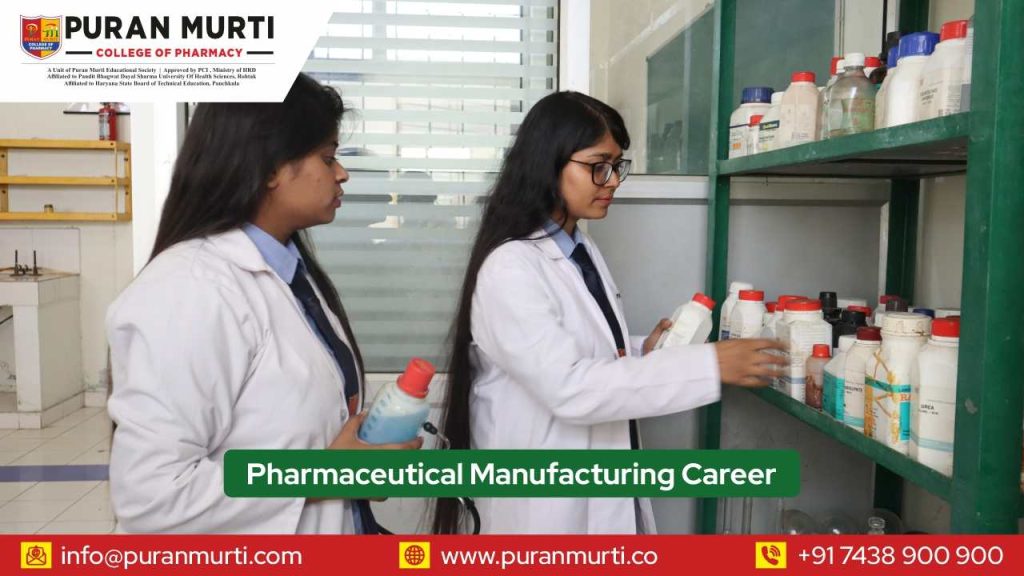
Pharmaceutical Manufacturing Career
Posted on : 23 September, 2026 12:57 pm
A pharmaceutical manufacturing career can be a strong choice for students interested in medicines, science and healthcare.
Pharmaceutical professionals help produce safe and effective medicines. They work in production plants, quality-control laboratories and research departments.
The industry offers jobs in production, quality assurance, quality control, packaging, research and regulatory affairs. Graduates can also move into management roles with experience.
What Is Pharmaceutical Manufacturing?
Pharmaceutical manufacturing is the process of making medicines on a large scale.
It includes:
- Researching formulations.
- Selecting raw materials.
- Preparing medicines.
- Testing samples.
- Packaging products.
- Recording batch details.
- Checking product quality.
- Following safety rules.
- Releasing medicines for sale.
Manufacturing plants produce tablets, capsules, syrups, injections, creams and other products.
Every step follows strict quality and safety procedures. This helps protect patients and maintain product consistency.
Why Choose This Career?
A pharmaceutical manufacturing career combines science with practical work.
You may enjoy this field if you:
- Like Chemistry and Biology.
- Want to work in healthcare.
- Enjoy laboratory work.
- Prefer organised processes.
- Pay attention to detail.
- Like solving production problems.
- Want a stable industrial career.
The work can be challenging. However, it offers many opportunities in India and abroad.
About Puran Murti Vidyapeeth
The institute is known for its focus on technical education, practical learning, laboratory exposure, and career-oriented training. Students can explore engineering programs in modern technology domains while benefiting from academic support, industry interaction, and campus facilities. The availability of hostel facilities, skill-development activities, and placement assistance also makes it a consideration for students looking for engineering education near Delhi NCR. Apply Now
Top Engineering Branches
BTech (Bachelor of Technology)
BTech is among the most popular courses after 12th Science (PCM).
Top Specializations:
- Aeronautical Engineering
- Aerospace Engineering
- Aircraft Maintenance Engineering (AME)
- Computer Science & Engineering (CSE)
- CSE with Artificial Intelligence and Machine Learning (AI & ML)
- Civil Engineering
- Electrical Engineering
- Electronics & Communication Engineering (ECE)
- Mechanical Engineering
Unique Aviation Programs (USP)
One of the biggest advantages of Puran Murti Vidyapeeth is its aviation-based courses, which are rare in India:
- B.Tech + AME (DGCA approved)
- B.Tech Mechanical Engineering + AME (DGCA)
- B.Tech ECE + AME (DGCA)
- B.Tech Computer Science
(AI & ML)+ AME (DGCA) - B.Tech Aeronautical Engineering
+ CPL (Ground Classes) - B.Tech Aerospace Engineering
+ CPL (Ground Classes)
Diploma Courses
Students can also choose job-oriented diploma courses: Apply Now
- Diploma in Automobile Engineering (AE)
- Diploma in AME (Aircraft Maintenance Engineering)
- Diploma in Aeronautical Engineering
- Diploma in Civil Engineering (CE)
- Diploma in Mechanical Engineering (ME)
- Diploma in Computer Science & Engineering (CSE)
- Diploma in Electronics & Communication Engineering (ECE)
- Diploma in Electrical Engineering (EE)
- Diploma in Fire Technology & Safety
- Diploma in Medical Lab Technology (MLT)
- Diploma in Hotel Management
- Diploma in CSE (AI & ML)
Courses for Pharmaceutical Manufacturing
B.Pharm
Bachelor of Pharmacy is one of the most common courses for this field. It usually takes four years.
Students study:
- Pharmaceutics.
- Pharmaceutical chemistry.
- Pharmacology.
- Pharmacognosy.
- Pharmaceutical analysis.
- Industrial pharmacy.
- Quality assurance.
- Drug regulations.
B.Pharm graduates can apply for production, quality and regulatory roles. Industry salary guides commonly list production, quality control and research as major career paths after B.Pharm.
M.Pharm
Master of Pharmacy helps students specialise in a particular area.
Useful specialisations include:
- Pharmaceutics.
- Industrial pharmacy.
- Quality assurance.
- Pharmaceutical analysis.
- Pharmacology.
- Pharmaceutical technology.
An M.Pharm may help you move into research, teaching or senior industry roles.
Diploma in Pharmacy
D.Pharm is a shorter pharmacy programme. It can help students enter pharmacy practice and some entry-level roles.
Students should check the eligibility and registration rules for each job. A B.Pharm may provide wider opportunities in manufacturing and research.
B.Sc. Chemistry
Chemistry graduates can work in quality-control laboratories and chemical manufacturing. Some companies hire graduates for testing and analytical roles.
Additional training in GMP, laboratory instruments and pharmaceutical analysis can improve job prospects.
Biotechnology and Microbiology
Biotechnology and microbiology graduates may work in sterile manufacturing, vaccines, biologics and quality testing.
These fields are useful for students who want to work with biological medicines and advanced production methods.
Chemical Engineering
Chemical engineers help design and improve large-scale manufacturing processes.
They may work with:
- Process design.
- Equipment.
- Heat transfer.
- Fluid systems.
- Process safety.
- Production efficiency.
This course can be useful for API and bulk-drug manufacturing.
Main Areas of Work
A pharmaceutical plant has many departments. Each department has a specific responsibility.
Production
The production team manufactures medicines according to approved instructions.
Production professionals:
- Operate manufacturing equipment.
- Follow batch records.
- Monitor processes.
- Check production conditions.
- Report deviations.
- Meet production targets.
- Follow safety procedures.
Common job titles include Production Officer, Production Executive and Production Supervisor.
Quality Control
Quality Control tests raw materials, products and finished medicines.
QC professionals use laboratory instruments to check:
- Strength.
- Purity.
- Stability.
- Dissolution.
- Microbial quality.
- Physical appearance.
Common roles include QC Analyst, Quality Control Officer and Laboratory Executive.
Quality Assurance
Quality Assurance creates systems that prevent quality problems.
QA professionals review:
- Standard operating procedures.
- Batch records.
- Deviations.
- Change controls.
- Corrective actions.
- Preventive actions.
- Audit reports.
QA is an important area for students who enjoy documentation and compliance.
Research and Development
Research and Development teams create new formulations and improve existing products.
They may work on:
- New drug formulations.
- Generic medicines.
- Tablets and capsules.
- Injections.
- Stability studies.
- Process development.
- Scale-up activities.
Higher qualifications may help students enter advanced R&D roles.
Packaging
The packaging team protects medicines and prepares them for distribution.
Professionals check:
- Packaging materials.
- Labels.
- Batch numbers.
- Expiry dates.
- Packing machines.
- Product information.
Packaging must follow approved procedures. Errors can affect patient safety.
Regulatory Affairs
Regulatory Affairs teams communicate with government authorities. They prepare documents for product approval and compliance.
Their work may include:
- Preparing regulatory files.
- Checking legal requirements.
- Supporting product registration.
- Responding to authority questions.
- Maintaining product records.
- Tracking regulatory changes.
This area suits students who enjoy science, writing and documentation.
Popular Job Roles
A pharmaceutical manufacturing career can begin with entry-level jobs.
Popular roles include:
- Production Executive.
- Production Officer.
- QC Analyst.
- QA Executive.
- Microbiologist.
- Formulation Executive.
- Packaging Officer.
- Validation Executive.
- Regulatory Affairs Associate.
- Research Assistant.
- Warehouse Executive.
- Process Development Associate.
After gaining experience, professionals may become:
- Production Manager.
- QA Manager.
- QC Manager.
- Plant Head.
- Regulatory Manager.
- Research Scientist.
- Operations Director.
Skills Required
Employers look for technical and professional skills.
Good Manufacturing Practices
GMP is a key area in pharmaceutical manufacturing. It helps ensure consistent quality and safe production.
Students should understand:
- Cleanroom practices.
- Hygiene.
- Batch records.
- Process controls.
- Equipment cleaning.
- Documentation.
- Deviation handling.
Employers increasingly value knowledge of GMP, documentation and data integrity.
Documentation
Pharmaceutical plants generate many records. These records show what happened during production.
Learn how to work with:
- Standard operating procedures.
- Batch manufacturing records.
- Logbooks.
- Deviation reports.
- Change controls.
- CAPA records.
- Audit documents.
Laboratory Skills
QC and R&D professionals should understand laboratory methods.
Useful areas include:
- HPLC.
- UV spectroscopy.
- Dissolution testing.
- Titration.
- Microbiology.
- Stability testing.
- Sampling.
- Analytical documentation.
Equipment Knowledge
Production professionals should understand manufacturing equipment.
Examples include:
- Tablet compression machines.
- Coating machines.
- Fluid-bed dryers.
- Granulators.
- Mixers.
- Autoclaves.
- Filling machines.
- Blister packing machines.
Data Integrity
Data must be accurate, complete and traceable. Learn the importance of proper entries, signatures, dates and corrections.
Communication
Teams work together across production, quality, stores and engineering. Clear communication prevents mistakes.
Problem-Solving
Manufacturing can face equipment failures, process changes and quality issues. Employers value professionals who solve problems calmly.
Salary in India
Salary depends on qualification, experience, location and company.
A fresher may start with about ₹3 lakh to ₹7 lakh per year in production, quality or research roles. Some sources report entry-level industry salaries in this range for B.Pharm graduates.
The approximate salary pattern is:
| Experience | Estimated annual salary |
|---|---|
| Fresher | ₹3 lakh–₹7 lakh |
| 2–5 years | ₹5 lakh–₹10 lakh |
| 5–10 years | ₹8 lakh–₹18 lakh |
| Senior manager | ₹15 lakh–₹30 lakh or more |
These figures are estimates. Company size, location and job role can change the package.
Career Growth
Career growth usually follows a clear path.
A production professional may progress as follows:
- Production Trainee.
- Production Executive.
- Senior Executive.
- Assistant Manager.
- Production Manager.
- Plant Manager.
A quality professional may grow through these roles:
- QC Trainee.
- QC Analyst.
- Senior Analyst.
- Assistant Manager.
- Quality Manager.
- Head of Quality.
Professional growth depends on performance, technical skills and leadership ability.
Pharmaceutical Manufacturing Hubs
Pharmaceutical companies operate across many Indian regions.
Important hubs include:
- Hyderabad.
- Ahmedabad.
- Vadodara.
- Mumbai.
- Pune.
- Indore.
- Baddi.
- Visakhapatnam.
- Bengaluru.
- Chennai.
- Sikkim.
- Delhi-NCR.
Gujarat, Maharashtra, Telangana and Himachal Pradesh have strong pharmaceutical manufacturing activity. These regions offer opportunities in production, testing, packaging and quality.
Internship Opportunities
An internship can give you practical experience before your first job.
Try to gain exposure to:
- Production floors.
- Quality-control labs.
- Quality-assurance departments.
- Warehouses.
- Packaging units.
- Documentation systems.
- GMP audits.
During your internship, observe how teams follow procedures. Ask questions and maintain a learning notebook.
Industrial pharmacy guidance recommends completing internships at manufacturing facilities when possible. This can provide more relevant experience than only working in retail pharmacy.
Certifications That Can Help
Short courses can improve your resume. Useful topics include:
- GMP.
- Good Laboratory Practices.
- Good Documentation Practices.
- Quality assurance.
- Validation.
- Regulatory affairs.
- Data integrity.
- Pharmaceutical analysis.
- Excel and data reporting.
- Lean Six Sigma.
Choose a course with a clear syllabus and practical value. Do not collect certificates without building real skills.
Challenges in This Career
Pharmaceutical manufacturing is rewarding, but it also has challenges.
Shift Work
Plants may operate throughout the day. Some production and quality roles include night shifts.
Strict Documentation
Small documentation errors can cause serious problems. You must work carefully.
Production Pressure
Plants must meet targets while maintaining quality. Professionals may work under deadlines.
Limited Initial Salary
Freshers may start with a modest salary. Income grows with experience and specialisation.
Continuous Learning
Rules, equipment and manufacturing processes change. Keep updating your knowledge.
How to Start Your Career
Follow these steps to enter the industry.
Choose the Right Course
Select B.Pharm, M.Pharm, Chemistry, Microbiology, Biotechnology or Chemical Engineering according to your interest.
Learn Industrial Subjects
Focus on pharmaceutics, pharmaceutical engineering, analysis and quality assurance.
Gain Practical Training
Complete an internship in a manufacturing plant. Observe real processes and documentation.
Prepare Your Resume
Mention laboratory skills, software knowledge, projects and practical training.
Apply for Entry-Level Jobs
Search for Production Executive, QC Analyst, QA Executive and Packaging Executive roles.
Prepare for Interviews
Revise GMP, basic instruments, documentation, safety and your academic subjects.
Interview Questions
Employers may ask:
- What is GMP?
- What is a batch manufacturing record?
- What is the difference between QA and QC?
- What is a deviation?
- What is CAPA?
- What is validation?
- What is data integrity?
- How does HPLC work?
- Why do you want to work in production?
- How would you handle a manufacturing error?
Prepare short and clear answers. Use examples from your internship or academic projects.
Higher Studies
Higher studies can help you move into advanced roles.
Options include:
- M.Pharm in Industrial Pharmacy.
- M.Pharm in Quality Assurance.
- M.Pharm in Pharmaceutics.
- MBA in Pharmaceutical Management.
- M.Sc. in Industrial Chemistry.
- PhD in Pharmaceutical Sciences.
- Diploma in Regulatory Affairs.
- Diploma in Clinical Research.
Pharmaceutical Manufacturing at Puran Murti Vidyapeeth
Puran Murti Vidyapeeth in Sonepat, Haryana, offers education in pharmacy and other professional fields. Its published course information includes B.Pharm and D.Pharm programmes.
Students interested in pharmaceutical manufacturing can explore pharmacy education and develop a foundation in:
- Pharmaceutics.
- Pharmaceutical chemistry.
- Pharmacology.
- Pharmaceutical analysis.
- Industrial pharmacy.
- Quality assurance.
- Laboratory practices.
The Delhi-NCR location can provide access to hospitals, pharmaceutical companies, laboratories and other healthcare organisations.
Before admission, students should verify:
- Course approval.
- University affiliation.
- Laboratory facilities.
- Practical training.
- Internship support.
- Fee structure.
- Eligibility rules.
- Placement information.
Puran Murti Vidyapeeth also offers other professional courses. This can help students compare pharmacy with engineering, law, management and vocational programmes.
Who Should Choose This Career?
Choose pharmaceutical manufacturing if you:
- Enjoy science and healthcare.
- Like organised work.
- Have good attention to detail.
- Can follow written procedures.
- Want to work in an industrial setting.
- Are comfortable with documentation.
- Want to improve medicine quality.
This field may not suit you if you dislike laboratory work, strict processes or shift schedules.
Final Thoughts
A pharmaceutical manufacturing career offers opportunities in production, quality control, quality assurance, research and regulatory affairs.
B.Pharm is a common entry route. Chemistry, biotechnology, microbiology and chemical engineering can also lead to relevant roles.
Build knowledge of GMP, documentation, laboratory instruments and pharmaceutical processes. Gain practical experience through internships.
Puran Murti Vidyapeeth offers pharmacy programmes for students who want to build a foundation in pharmaceutical sciences. Verify the latest approvals, fees and admission details before applying.
With the right education and practical skills, you can grow from an entry-level executive to a senior professional or plant manager.
FAQs
What is a pharmaceutical manufacturing career?
It is a career in making, testing, packaging and improving medicines. Professionals work in production, quality, research and regulatory departments.
Which course is best for pharmaceutical manufacturing?
B.Pharm is one of the most common choices. M.Pharm, Chemistry, Biotechnology, Microbiology and Chemical Engineering can also lead to relevant roles.
What is the starting salary in pharmaceutical manufacturing?
Freshers may earn around ₹3 lakh to ₹7 lakh per year. The actual salary depends on qualification, employer, city and job role.
What does a production executive do?
A production executive monitors manufacturing processes. The role includes equipment operation, batch records, safety and production planning.
What is the difference between QA and QC?
Quality Control tests materials and products. Quality Assurance manages systems that prevent quality problems.
Is GMP important for a pharma career?
Yes. GMP supports consistent quality, safe production and proper documentation. Employers value candidates who understand GMP.
Does pharmaceutical manufacturing involve shift work?
Some plants operate in shifts. Production, maintenance and quality roles may include evening or night shifts.
Can freshers get jobs in pharma manufacturing?
Yes. Freshers can apply for trainee, production, QC, QA, packaging and laboratory roles.
Does Puran Murti Vidyapeeth offer pharmacy courses?
Published information lists B.Pharm and D.Pharm programmes at Puran Murti Vidyapeeth. Confirm the current course details directly with the institution.
Is pharmaceutical manufacturing a good career?
It can be a good career for students who enjoy science, healthcare, laboratory work and organised industrial processes. Growth depends on skills, experience and performance.